Niigata Prefecture
Blind Willow, Sleeping WomanNiigata Prefecture is the setting of a young narrator’s temporary job as a night watchman at a junior high school. The school’s ordinary routines—two nightly rounds, a checklist, and a quiet janitor’s room—give way to an experience he has kept secret for more than ten years, making the prefecture the landscape of a remembered encounter with fear.
Setting and the Narrator’s Work
In the fall of his second year of wandering around Japan, the narrator takes a job for a couple of months at a school in a tiny town in Niigata Prefecture. Having grown tired from manual labor over the summer, he wants a period of easier work. During the day he sleeps in the janitor’s office; at night he checks the school and spends his unassigned hours listening to records in the music room, reading in the library, or playing basketball alone in the gym. At eighteen or nineteen, he says, he is not afraid to be alone in the building.
The school is a fairly new, three-story concrete structure, with eighteen to twenty classrooms as well as a music room, home economics room, art studio, staff office, and principal’s office. The wider grounds include a separate cafeteria, swimming pool, gym, and auditorium. His rounds take him through these spaces, making the job a repeated circuit through an otherwise empty institution.
Nightly Routine and Its Defenses
The watchman is required to make two rounds each night, at nine p.m. and three a.m. He follows a twenty-point checklist, marking each location as he checks it. Rather than stay in bed and fill out the list without walking the school, he makes the rounds in person; he reasons that if someone breaks in while he sleeps, he would be the one attacked. At each round he carries a flashlight in his left hand and a wooden kendo sword in his right. His high-school practice makes him confident he could fend off an amateur attacker, though he later admits that he would run if faced with the same prospect as an adult.
One windy night at the beginning of October, the ordinary circuit is accompanied by oppressive weather: the night is unusually steamy, mosquitoes swarm, and he burns mosquito-repellent coils. The broken gate to the swimming pool bangs open and shut in the wind. He considers fixing it but decides it is too dark. His nine o’clock round is uneventful: all twenty items are checked, every door is locked, and everything appears in place. He returns to the janitor’s room, sets his alarm for three, and falls asleep.
A Routine Interrupted
When the alarm sounds at three, the narrator wakes with an unfamiliar reluctance to get out of bed, as though something is suppressing his will. The pool gate continues its rhythmic banging, but now sounds different to him. He senses that something is wrong, yet insists on completing his duty: he believes that skipping it once could lead to skipping it again. He takes his flashlight and wooden sword and sets out on the second round.
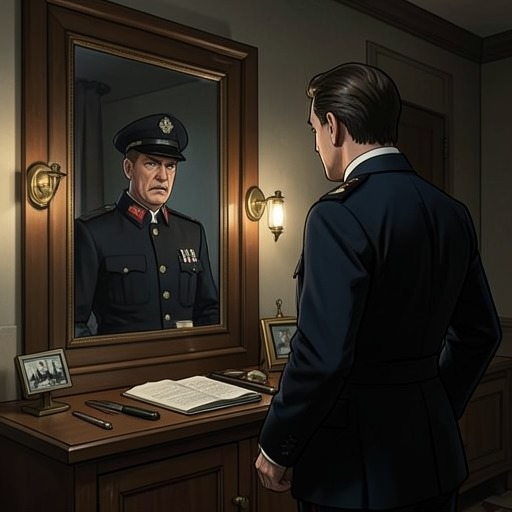
The narrator recounts the experience at a later gathering, explaining that it happened more than ten years earlier and that he has never told anyone because speaking about it might make it happen again. His account places the unsettling turn inside the most regular part of his work: the scheduled three a.m. inspection, after an entirely normal first round. Niigata’s school is thus not simply a remote workplace but the setting in which an ordinary, carefully checked night becomes the beginning of a story the narrator has long been afraid to tell.